
The Green Pastures (1936) Starring Rex Ingram, Oscar Polk, & Eddie “Rochester” Anderson
The Green Pastures
Recently, I read the book Black Skin, White Masks (1967) by the brilliant Frantz Fanon who mentions the film: The Green Pastures (1936). He describes the author Mayotte Capécia’s impression of the film: “…But there is the film Green Pastures, where God and the angels are black, that gave the author a terrible shock: “How can God be conceived with Negro features? That’s not my idea of Paradise. But, after all, it’s only an American film” (page 34).1 This film was unknown to me and the idea of a vintage Hollywood depiction of an African-American heaven was so intriguing, my reading was paused to search for the film.
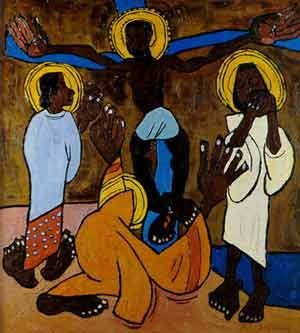
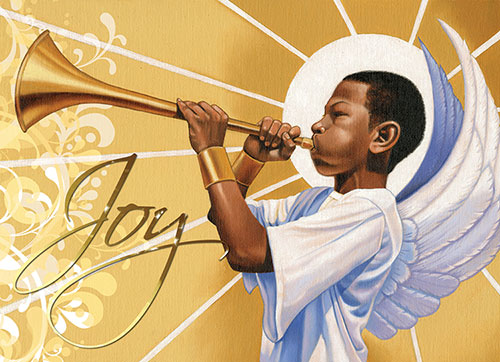
I had seen Black angels as dolls and Christmas ornaments and tried to remember my earliest memory of a Black heaven on film. The answer arose as the music video “I Ain’t Mad At Cha” by Tupac Shakur (1996). I found the film available for rental on Amazon and immediately watched it. Prepared to encounter the possibility of cruel stereotypes and propaganda, I had no idea what to expect.
–Hebrews 13:2, KJV Holy Bible
This folktale film begins with the foreword: “God appears in many forms to those who believe in Him. Thousands of Negroes in the Deep South visualize God and Heaven in terms of people and things they know in their everyday life. The Green Pastures is an attempt to portray that humble, reverent conception.” The film centers around a Sunday school lesson in Louisiana, where inquisitive children ask insightful questions to the preacher, who explains in cultural terms the kingdom of the Lord, angels, and the frailties of humankind.
As a native Southerner, there was recognition of some old colloquialisms and customs that have contemporary modes of kin. It’s a very enjoyable film that does not bombard the audience with offensive stereotypes, especially given the 1930s time period. But that does not mean they are completely absent either. Those who have watched old biblical-style films will feel a sense of familiarity with The Green Pastures.

–Galatians 3:28 KJV Holy Bible
The film also offers the opportunity to explore artistic depictions of the Lord, biblical characters, angels, and ultimately Jesus, as something other than White. Most religious portrayals of Jesus the Christ come from a Eurocentric worldview, that has traditionally been used to support their own racial domination. And it has been historically inaccurate. We must remember, the Hebrews were a part of the Semitic-speaking people groups in a region of the world composed of various people of color groups.
According to historian Dr. John Henrik Clarke: “Now you can argue about the colorization of Christ if you want to. But I can settle that very quickly and we can go on to the next subject. Was he a Roman? The answer is no. Was he a Greek? The answer is still no. These are the only European-types in that part of the world at the time. If he was neither Roman or Greek, then he was one of those other people. And all of those other people were non-European and non-White. And he came from the other people.” (time-mark 39:16) 2
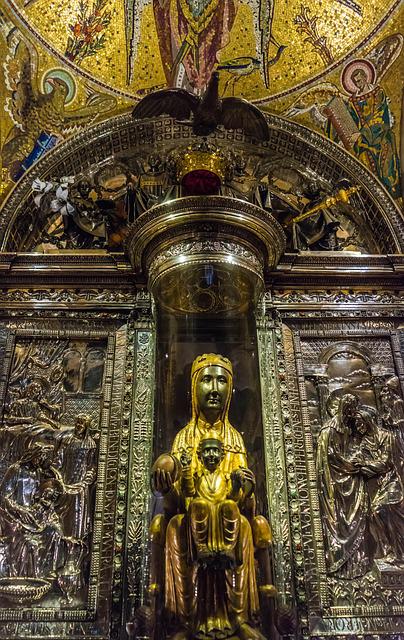
There is another early work, the Black Virgin of Montserrat in Spain (1844) that portrays a Black Madonna and Christ child. The work is believed to have been originally created in Jerusalem and is made of wood. The museum cites her dark color as a result of aging over time and does not represent African ancestry. However, there are others who debate and disagree on this point.
Today, there is a growing racial diversity of Christian religious artwork in society. But the distinction between an artistic interpretation and historical accuracy must be maintained. Above all, biblical scripture must be the bread of truth for those who choose to create religious art and those who choose to purchase it. Motivations must be analyzed for each believer.
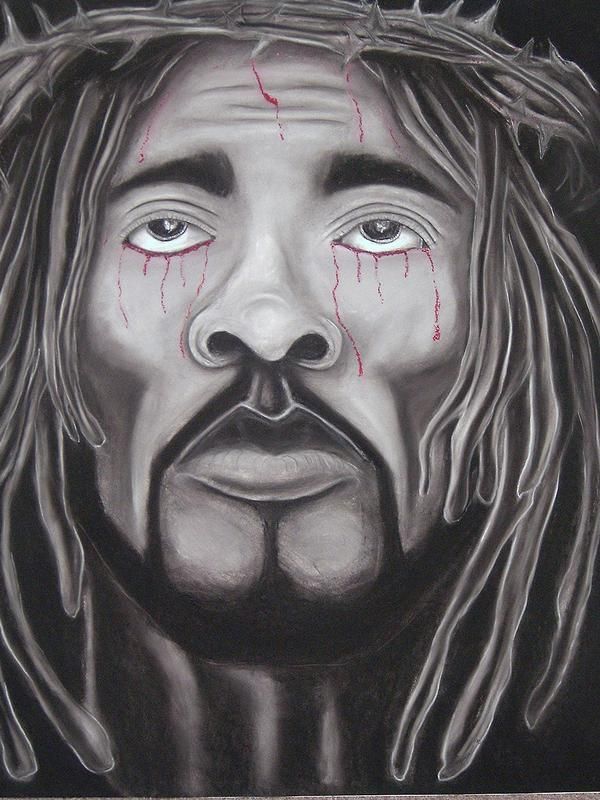
On a personal note, I will say in my childhood home no image of a European Jesus hung on our walls. Instead, the portrait of a Black Jesus with dreadlocks was hung. Later, after a greater spiritual understanding was gained, no graven images of Jesus hung on our walls. Not Black, White, or otherwise.
As someone who enjoys art, film, and literature, I appreciate religious depictions and provide my personal example to give context to the discussion. It is not an opposition to religious artwork. Overall, the film: The Green Pastures has a genuine spirit of dignity. Be sure to watch the short film clip of “Noah” at the end of this newsletter.
Bibliography:
(1.) Fanon, Frantz. Black Skin, White Masks (p. 34). Grove Atlantic (1967). Kindle Edition.
(2.) “John Henrik Clarke – A Great and Mighty Walk” YouTube video, 1:34. “Prince Amir,” August 12th, 2012. https://www.youtube.com/watch?v=njdQzyQnHeg
*Notice: The Green Pastures film was first published in the August 2020 Edition and as an expanded film review in August 2022.
Video (6)
Michael Stevenson on YouTube
Kinigra Deon on YouTube
Rod of God Comedy on YouTube
Because of the Times on YouTube
The BL & S Singers on YouTube
1997 Live Performance
Christian Life Center on YouTube
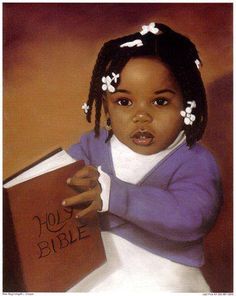
–Amos 9:7 KJV Holy Bible

Discover more from Sankofa Newsletter
Subscribe to get the latest posts sent to your email.
 Sankofa Newsletter