
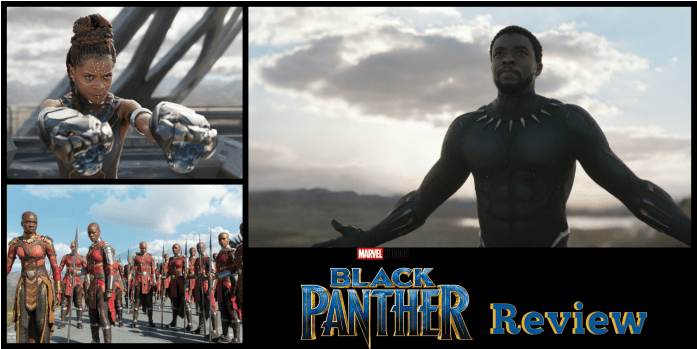
Starring Chadwick Boseman, Michael B. Jordan, and Lupita Nyongo
*Notice: This film review contains spoilers. I wrote this film review essay in February 2018 (the day after watching the film) and it provides my very first impression of the film. The Sankofa Newsletter Blog was not in physical existence at that time, it was only an idea. But I wrote some reviews (including this one) for future publication. I also plan to watch the newest film: Black Panther: Wakanda Forever (2022).
Black Panther: Wakanda and The Politics of Isolationism
The Marvel Comics film Black Panther introduces us to the futuristic and technologically advanced civilization of Wakanda, located in Africa. The protagonist, T’Challa, is an heir to the royal throne, who must confront other potential contenders in an ancient ritual battle to the death. T’Challa’s success in this initial battle crowns him the King of Wakanda and the superhero Black Panther. While his physical strength is evident, it is his inner strength and idealism that continues to challenge his rule.
The antagonist, Erik Killmonger, an Oakland California native, who holds dual nationality to both America and Wakanda, seeks the royal throne for a global agenda. His lineage includes a mother descended from enslaved Africans in America and a father of Wakandan heritage. His passion and anger, at its core, is fueled by abandonment and righteous indignation at the plight of the African diaspora. However, this same passion and anger threatens to consume him and perhaps, he even welcomes the flames.

This film provides many different viewpoints that can be drawn for critique and analysis. Often, I was thinking this film and its review would be great for a college course. But the main viewpoint that stood out for me was the element of isolationism. The first few scenes in the film show a meteor crash, that releases the precious and powerful metal Vibranium, which enriches the nearby human population. Because of Vibranium the civilization of Wakanda becomes prosperous and technologically advanced. Despite outside world affairs, including scene images of the Transatlantic Slave Trade, Wakanda shows itself strong and proud. These initial scenes lead to question the ethics and morality of such a nation, that chose not to intervene on behalf of their neighbors, the enslaved and colonized Africans. So, there is a seed sown in opposition to the idealism and utopian vision of Wakanda.
To protect itself, Wakanda poses as a developing country and hides its supply of Vibranium from outsiders. The nation also sends spies across the globe in service to Wakanda. These maneuvers are not surprising, as many advanced nations conceal their own natural resources and scout out threats and opportunities to advance their own economic and socio-political agendas.

The practice of espionage introduces two spy characters, N’Jobu (Killmonger’s father) and Nakia (T’Challa’s ex-girlfriend). N’Jobu is stationed in Oakland California, where he becomes sympathetic and takes up arms for the socio-political cause of African-Americans. He also chooses a woman from that population and fathers a son. The trauma of his death leaves a young Killmonger abandoned and helps ignite a self-determination to “learn the system by becoming apart of the system” through military service and CIA training.
Nakia operates in neighboring African countries and South Korea. She poses as a refugee to assist with the rescue of kidnapped young women by militants. She even gallantly steps-in to protect a child soldier that Black Panther is ready to attack, by informing him that the child soldier is also a kidnap victim. Nakia shows loyalty to the nation of Wakanda and of course to T’Challa, her former flame. She is committed to helping others outside the Wakandan borders and this speaks to her “calling” that T’Challa later recognizes and supports. These spy characters provide the dichotomy of identity-isolation politics practiced on the individual level in the greater society.

The closed society of Wakanda is composed of several different African tribes that maintain homogeneous ancient traditions but hold various perspectives, though most agree that T’Challa should be king. Opposed to this majority opinion are Erik Killmonger and the J’bori tribe. The J’bori’s leader M’Baku (my favorite character in the film) expresses fatigue with the politics of the former king T’Chaka, and anticipates T’Challa his son, will be more of the same. His specific grievances are not given, but his resolve to challenge for the throne is accompanied by a distinctive bark and a good fight scene. Is it possible M’Baku’s political concerns include objection to the policy of isolationism? Maybe. But the victory of the fight goes to T’Challa and M’Baku accepts defeat not death. His survival ensures continued service to his tribe.
The J’bori tribe live high in the snow-capped mountains and it is quite apparent they are proud to keep their own counsel on political affairs. They can be opposed to both other tribes in Wakanda and outsiders. It’s the J’bori tribe that T’Challa’s mother and sister flee to for protection and then discover the tribe had already recovered the wounded T’Challa. M’Baku repays his moral debt to T’Challa in the form of life for a life. When T’Challa’s supporters call Killmonger a murder, it is M’Baku who reminds them that the ancient ritual battle victory goes to Killmonger. He also states J’bori warriors will not be supplied to them in their struggle. He later decides to send warriors to the battle, as its their prerogative to keep their own counsel. I found the character of M’Baku composes a good balance between wisdom, morality, and power. Oh yeah, he was very funny!

The characters of T’Challa and Killmonger are engaged in a power struggle for the monarchy of Wakanda. T’Challa is an idealistic king who is not significantly interested in the plight of the African diaspora. He powerful states “I am not the king of all people, I am the King of Wakanda.” This profound statement makes it clear his upbringing, isolationist stance, and loyalty to their own tribes. The fact that they share the same skin color with their neighbors on the continent and elsewhere, does not guarantee acceptance into their culture and community. Wakanda forever! Let that sink in for a moment, because it can be a tough pill for some to swallow. However, even in Wakanda there are differences of opinion among the tribes in the nation to which they all belong. T’Challa receives a dose of realism that interrupts the Utopian vision of Wakanda in three main ways: 1.) The relationship with Nakia exposes him to her “calling” to help others beyond the borders of their nation 2.) the exposure of his father’s secret 3.) being challenged by his American cousin Killmonger. Ultimately, T’Challa has to confront his own bias and the mistake of his father.
The character of Erik Killmonger is a self-determined military and CIA spec-ops soldier, who is highly aware of the plight of the African diaspora. In his early life he experienced the traumatic death of his father and suffered abandonment twice. First by his father, then by his father’s people. His upbringing was strictly rooted in the realism of personal tragedy and the racial politics of oppression. Killmonger’s passion and anger fuels his resolve to challenge T’Challa for the royal throne, but it also consumes him. His father, N’Jobu recognizes the lack of empathy in his son when they meet on the ancestral plane and he asks “No tears for me?” Killmonger explains bluntly that people die and then it is his father who weeps. He is victorious in the ancient ritual battle against T’Challa and ascends to the royal throne.
Killmonger immediately begins to implement a technological global agenda to free the African diaspora of racial oppression. His rise is opposed by several tribes of Wakanda. The General of the Dora Milaje remains loyal to the office in spite of her personal objection to Killmonger. He also gains an ally, W’Kabia, leader of an army of super-sized rhinoceros. Killmonger befriended him by providing the long awaited death of international criminal Klaue, killer of W’Kabia’s parents. In the final battle scene for the throne, debatable as a coup d’etat, T’Challa and his allies are victorious and he is restored as the King of Wakanda. Killmonger chooses death over survival in defeat, as he coins it further bondage.
The motivations of T’Challa and Killmonger challenge the balance between idealism and realism, especially in terms of culture, community, and the racial politics of oppression. Wakanda’s political policy of isolationism was used to protect their own natural resources and tribes from the outside world. Ironically, it was not outsiders that brought ideological conflict to their nation, but insiders. In particular, spies who moved around the globe and were influenced by the trials of the African diaspora. The political neutrality of the technologically superior Wakanda during the Transatlantic Slave Trade did not make them immune from the effects. Hence, the introduction of their African-American cousin, Killmonger. A nation-state is sovereign to protect its citizens and resources, but are their moral and ethical obligations to the plight of their neighbor countries? Yes, No, or Maybe?
We witness King T’Challa’s budding new perception that includes a more realistic understanding of the African diaspora. He seeks to reconnect through the opening of an Oakland community center. This action probably includes both altruistic and political motivations.

However, the end credit scene is a curiosity. It features King T’Challa accompanied by his entourage, speaking to an international forum. He reveals that Wakanda will share its resources with the world on the basis of a “one tribe” philosophy. The forum is puzzled by his revelation and questions ensue. King T’Challa then smiles. This is a curious move for a sovereign state to make without any concessions being made or gained. It alienates potential allies of various hues and ignores real threats that exist in the geopolitical world. If taken at face value, this move at its core does not represent altruistic nor political motivations, it represents something else – a bit of ego. It appears King T’Challa now has chosen to balance the dilemma between realism and idealism with dangerous egotism. If Wakanda wants to truly shed its politics of isolationism, it must first confront its own false belief of Wakanda being an Utopian-like society. A cautionary tale for a nation in possession of such technologically superior weaponry.
All that being said, this is a really good film with a talented cast of actors/actresses, beautiful costumes, superb cinematography and special effects. Definitely worth watching. You can critique the film from your viewpoint or not. Either way, just take time to enjoy this futuristic adventure. Have fun and don’t hog all the popcorn!
Video (3)
Marvel Entertainment on YouTube
2018
Dr. James Hassell on YouTube
February 2018
Black Men’s Roundtable on YouTube
March 2018
*Notice: This video contains expletive language that may be offensive to some viewers. Discretion is advised.


Copyright© Sankofa Newsletter 2019-2022 All Rights Reserved U.S.A.
Discover more from Sankofa Newsletter
Subscribe to get the latest posts sent to your email.
 Sankofa Newsletter