
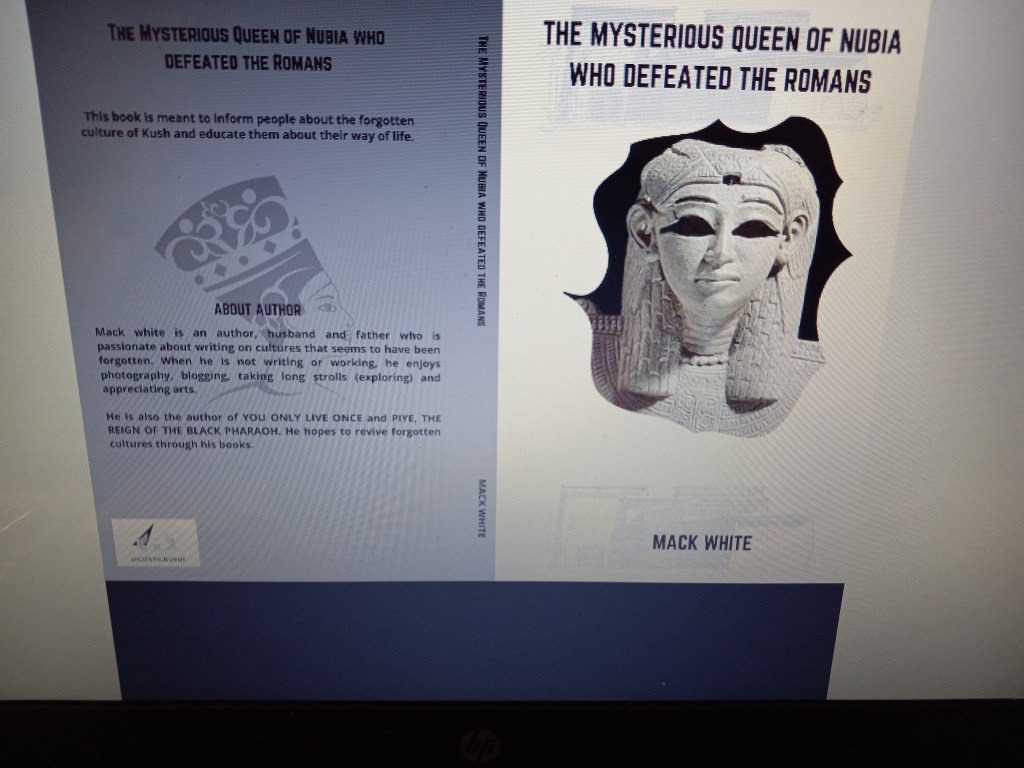
By Mack White (2020, 54 pages, kindle edition)
*Notice: This book review contains spoilers.
The Mysterious Queen of Nubia Who Defeated the Romans
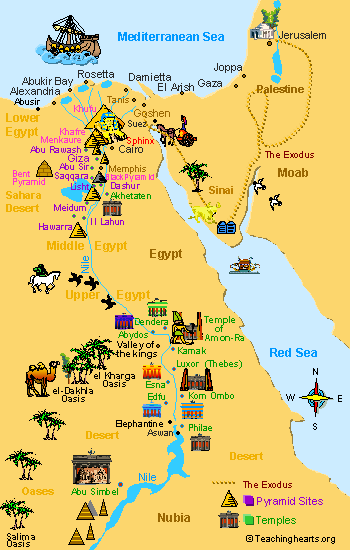
The land of Nubia (also known as Kush) was a powerful ancient civilization located in modern-day Sudan. The Nubian homeland was just south of Egypt (Kemet) and the two countries share a long geo-political history. In the 8th century B.C.E. (744 B.C.E.- 714 B.C.E.), the Nubian King Piye conquered Egypt, established the 25th dynasty, and ruled as pharaoh. But a lesser known historical fact involves Queen Amanirenas, who led Nubia in a war campaign against Rome. Learn more about her in the book: The Mysterious Queen of Nubia Who Defeated the Romans by Mack White (2020, 54 pages, kindle edition). This short book consists of ten chapters, a prelude, and postlude.

The prelude provides a view of the military operations conducted by Mark Antony, Queen Cleopatra, and Octavian. The following chapters focus on different aspects of the life of Queen Amanirenas and the war against Rome. The author writes of this remarkable queen: “She ascended the throne at the death of her husband, Emperor Teriqetas, who died in battle […]. She lost one of her eyes in battle, but she never relented and continued to fight to protect her people” (kindle loc. 234-238). “She beheaded the statute of him [Emperor Augustus Caesar] and buried it under the entrance way of her palace so her people could trample over it as a sign of defeat, this act was seen as an insult to the Romans […]” (kindle loc. 238). After five years of war, the Nubians and Romans signed a peace treaty. Queen Amanirenas remained on the throne until her death. She was succeeded by her sister Amanishakheto, who would also have to fight the Romans during her reign. The postlude includes a tidbit about a legend of the goddess who fell in love with a Nubian archer.
Overall, the book provides a good general overview of Queen Amanirenas and includes both photos and illustrations. The photos of Amanishakheto’s bracelet and collar are quite beautiful (housed in the Aegyptisches Museum Berlin). The book has sections of narrative storytelling, that in the absence of a formal reference list, leans toward the poetic license of the author. I appreciate the author’s exploration of what he calls “forgotten cultures.” A good read.
💖Recommended Additional Reading
Nubian Kingdom – Kushite Empire (Egyptian History) | Ancient History for Kids | 5th Grade Social Studies by Baby Professor (2017, 64 pages)
Nubians and their Northern Neighbor by Dwayne Wong (Omowale) (2016, 27 pages)
*Notice: Queen Amanirenas was first mentioned in the February 2021 Edition, to view click here
This is a repost of the original article “Bonus Book Review: The Mysterious Queen of Nubia Who Defeated the Romans” featured in October 2021.
Video (4)
CGTN Africa on YouTube
Home Team History on YouTube
Tedx Talks on YouTube
Legendarian on YouTube

Discover more from Sankofa Newsletter
Subscribe to get the latest posts sent to your email.
 Sankofa Newsletter