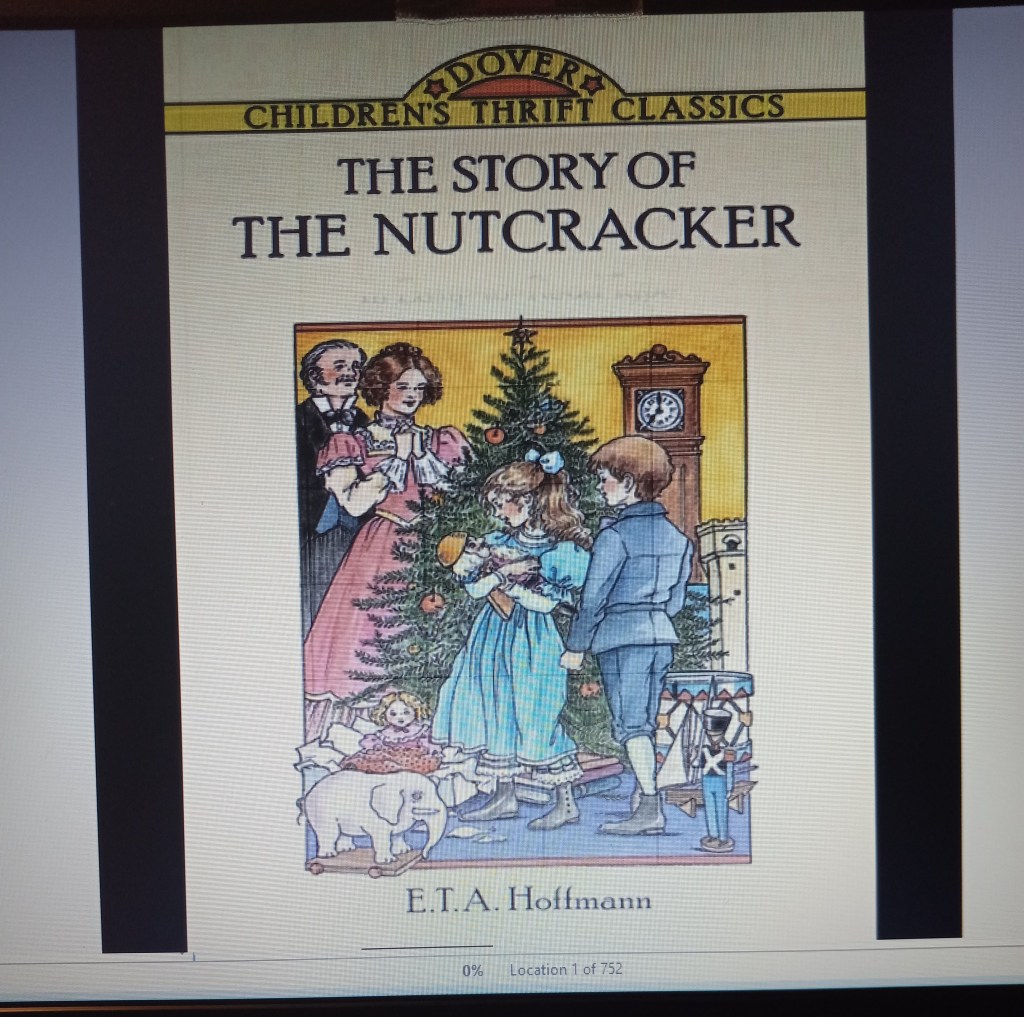
Translated by Major Alexander Ewing (1967), Adapted by Bob Blaisdell (1996) & Illustrated by Thea Kliros (1996). Dover Publications. Kindle Edition, 2012. 100 pages.

*Notice: This book review contains spoilers.
The Story of the Nutcracker
This holiday season take a trip to a magical kingdom in the book: The Story of the Nutcracker by E.T.A. Hoffman (1816). This German fairy tale was later adapted to ballet by Russian composer Tchaikovsky in 1892. The heroine of the story is young Marie, a sweet child, who anticipates the Christmas Eve visit of her godfather- Godpapa Drosselmeier. He always brings unique gifts for the family. Her siblings Fritz and Louise are also excited about his visit. He arrives and the children become enthralled by godpapa’s “yuletide fascinations.” Interestingly enough, in the text Christmas gifts are referred to as blessings from the “Christ Child” and there is no mention of Santa Claus. Marie admires the Christmas tree: “The great Christmas tree on the table bore many apples of silver and gold, and all its branches were heavy with sugar almonds, colored bon-bons, and all sorts of things to eat” (p. 7)… At some distance from the tree, there was a most interesting little man” (p. 12).1 Marie meets the Nutcracker and handles him gently with care. However, her brother Fritz is more rambunctious with the Nutcracker and wounds him. Marie acts as nurse to the little Nutcracker until late into the evening.

When the clock strikes midnight there are weird sounds as mice scurry across the floor with a Mouse King of seven heads who leads them. The toys in the children’s cupboard come alive and battle the mice. Fritz’s toy soldiers, the Nutcracker, and two Chinese emperors form a strong regiment against the mouse-battalion. As the battle rages, Marie does her best to intercede and then faints. She awakens in the morning with her parents at her bedside. Godpapa Drosselmeier explains to her the legend of Princess Pirlipat, the curse of Dame Mouserink, and the origin of the Nutcracker. Soon, Marie is visited by the Mouse King who demands sacrifices of her in exchange for the safety of the Nutcracker. She gives him her beloved sugar toys that includes young gentlemen and ladies in a Russian swing. But the greedy Mouse King is never satisfied and always demands more.

Marie receives a visit from the Nutcracker who informs her the Mouse King has been defeated. He invites her to a magical kingdom as a reward. They explore the magical land that has a Candy Meadow, Orange Brook, a King of Chocolate, and ballet. A colorful shell-shaped carriage guided by golden dolphins carries them across Lake Rosa, towards the city of Marzipan Castle. They admire the castle: “Then Marie and Nutcracker came before a castle shining in rosy light, with a hundred beautiful towers. Here and there upon its walls were bouquets of violets, tulips and carnations” (p. 72).2 They enjoy time at the castle and Marie returns home to solve remaining questions about the plight of the Nutcracker.
This is an enjoyable fairy tale that has a bit of Gothic elements, so may be more suitable for older children. The writing of this translation was clear and easy to follow. The black and white illustrations were a nice addition.

The Story of the Nutcracker has been adapted to ballet and has various versions of retelling. Traditionally, the Nutcracker Ballet is performed in silence with dance telling the story. The dancers have primarily and historically been of European ancestry. The Hot Chocolate Nutcracker created by Debbie Allen incorporates narrative storytelling, has many African-American dancers, and includes diverse forms of dance, such as Hip-Hop. The film documentary: Dance Dreams: Hot Chocolate Nutcracker (2020) features Allen’s dance academy and her students. One student, Kylie explains her perspective on being African-American in the world of ballet: “The craft that chose me was not created in my image” (time-mark 52:10).3 Debbie Allen speaks on the future of dance: “The dance world is evolving” (time-mark 51:00). 4 This was a very good documentary to watch.
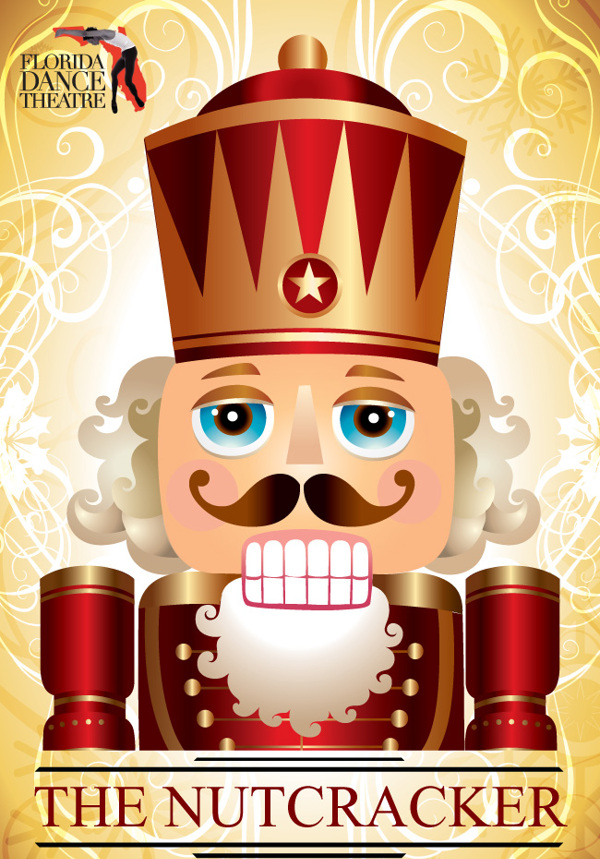
Ballerina Charlotte Nebres, a biracial young lady of color, became the first “Black” star of the New York City Nutcracker Ballet. She speaks of her accomplishment: “My instant reaction was, I was kinda shocked. That even in these recent times it hasn’t happened yet” (time-mark 2:04).5 Out of the mouth of babes! The Thomas Armour Youth Ballet & New World School of Arts did an outstanding performance of the Nutcracker (2017) in Florida. I posted it below for your holiday enjoyment. Merry Christmas and Happy New Year everyone!
Bibliography
(3, 4 ) Dance Dreams: Hot Chocolate Nutcracker, directed by Oliver Bokelberg. (2020, United States: Netflix), Documentary Film.
(1, 2 ) Hoffmann, E. T. A. The Story of the Nutcracker. Dover Publications. Kindle Edition (2012).
( 5 ) “Meet the First Black Star of New York City Ballet’s Nutcracker” YouTube video, 6:15. “Today,” December 16th, 2019. https://www.youtube.com/watch?v=_4WHVRzaohw
💖Purchase/Read the Book Synopsis here
Video (6)
Sophie’s Studio on YouTube
The Nutcracker (A Little Golden Book) by Rita Balducci & Illustrated by Sheila Beckett
Witchita Public Schools on YouTube
The Nutcracker in Harlem by T.E. McMorrow & Illustrated by James Ransome
The Floating Bubble on YouTube
The Nutcracker’s Night Before Christmas by Keith Brockett & Illustrated by Joseph Cowman
CBS Mornings on YouTube
Charlotte Nebres, Ballerina
Netflix on YouTube
Armour Dance Theatre on YouTube
Miami Dade County Auditorium, Florida
December 2017



Discover more from Sankofa Newsletter
Subscribe to get the latest posts sent to your email.
 Sankofa Newsletter